










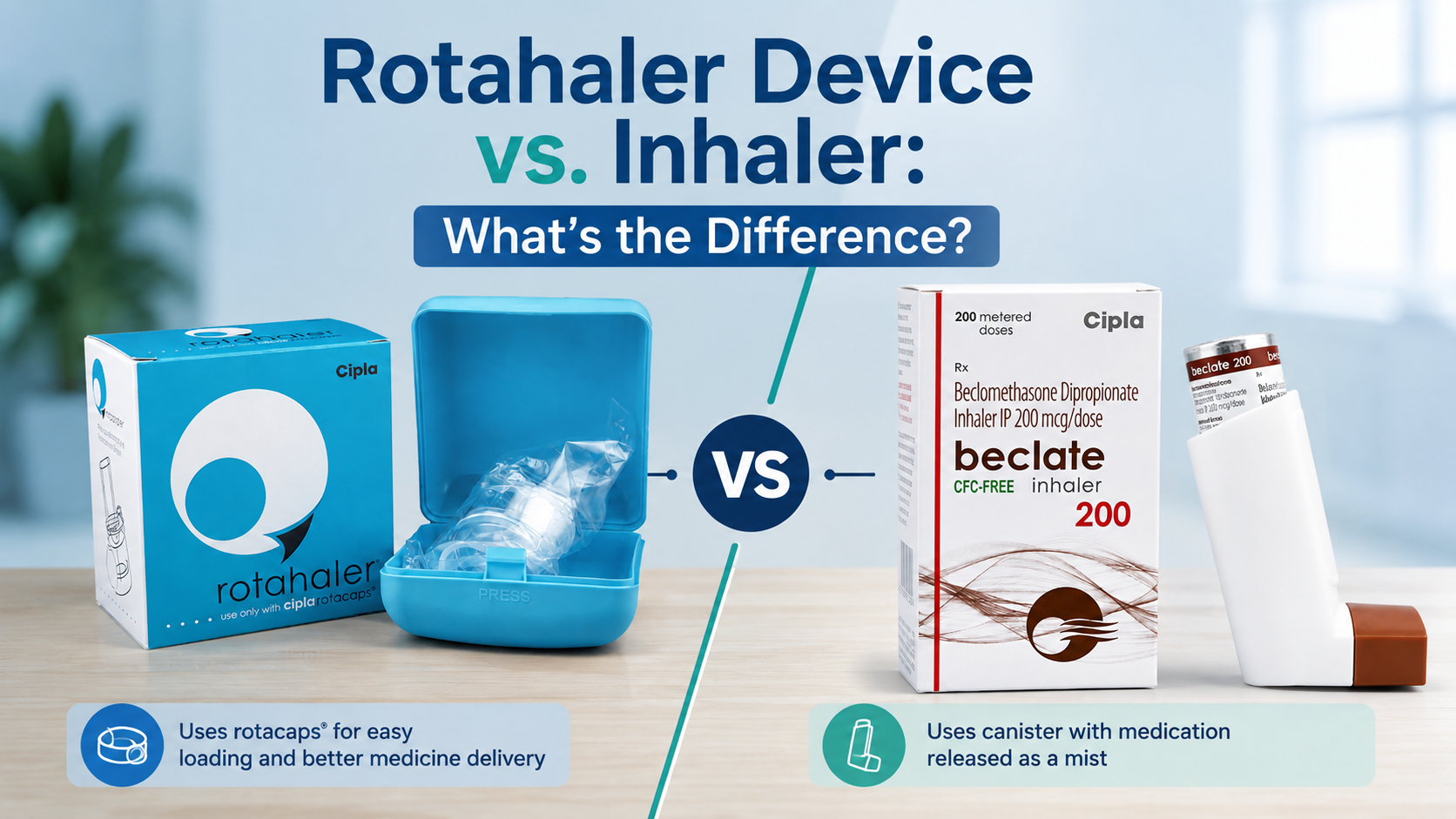
If your doctor has just prescribed you a respiratory device, you have probably noticed there is more than one kind — and they do not work the same way. A Rotahaler looks and feels completely different from the small canister-style inhaler most people picture when they hear the word “inhaler,” and using the wrong technique on either one can mean the medicine never actually reaches your lungs.
This guide breaks down exactly what a Rotahaler is, how it differs from a standard metered-dose inhaler (MDI), which devices fall into each category, and how to use both correctly. Getting this right matters more than most patients realise — studies on inhaler technique consistently find that a large share of users make at least one critical error, which can mean a big part of every dose is wasted.
- What Is a Rotahaler?
- What Is an Inhaler (MDI)?
- How a Rotahaler Works
- How an MDI Inhaler Works
- Rotahaler vs Inhaler: Key Differences
- Devices Similar to the Rotahaler
- Common MDI Inhalers
- How to Use a Rotahaler Correctly
- How to Use an MDI Inhaler Correctly
- Pros and Cons of Each
- Which One Is Right for You?
- Common Mistakes to Avoid
- Cleaning and Storage
- Frequently Asked Questions
- Conclusion
- Medical Disclaimer
What Is a Rotahaler?
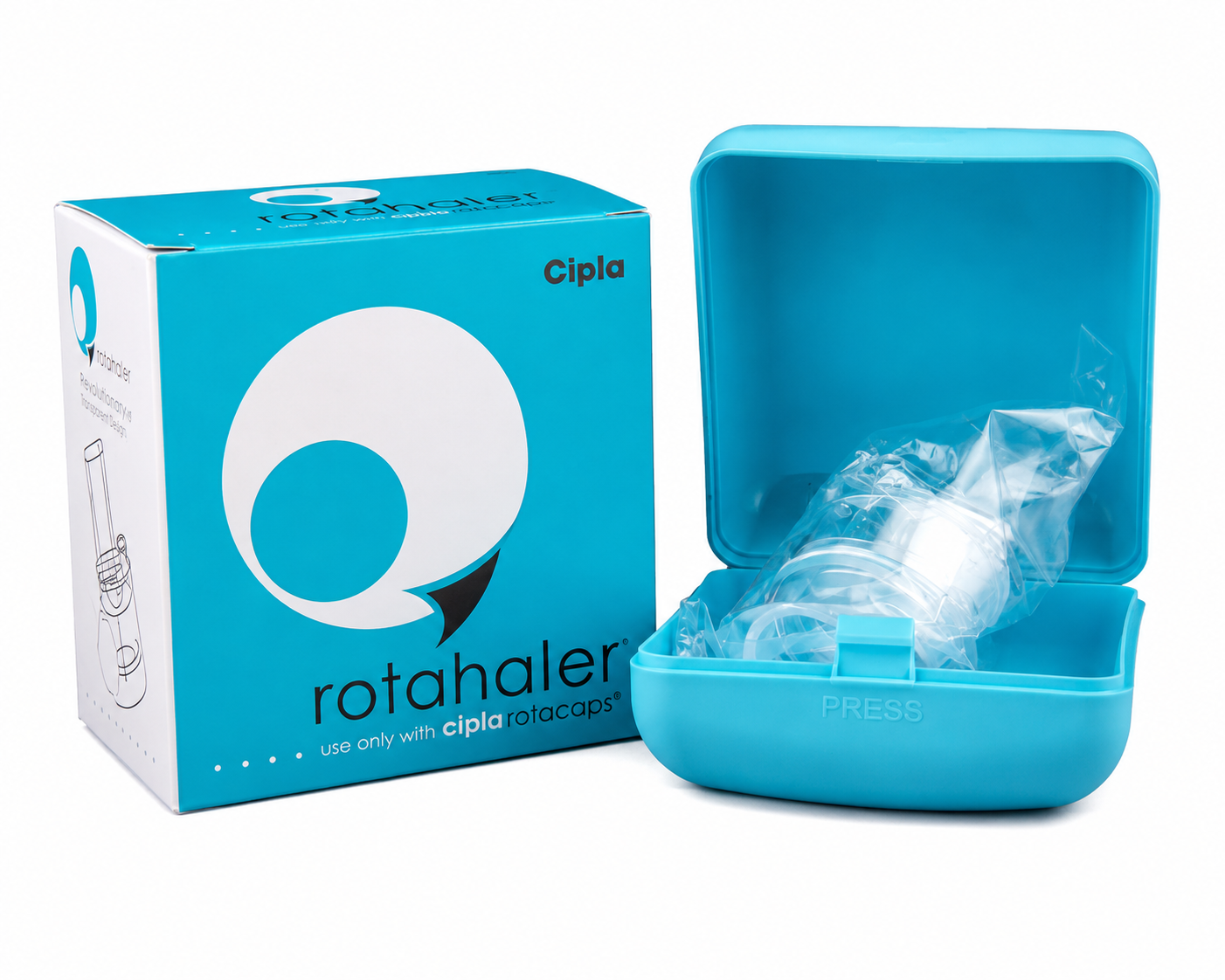
A Rotahaler is a type of dry powder inhaler (DPI) — a reusable plastic device that delivers medication in powder form, loaded one dose at a time from a small capsule. Instead of a pressurised canister, it works entirely on the strength of your own inhalation: you break open a capsule inside the device and breathe the released powder deep into your lungs.
The Rotahaler Device itself is simply the reusable holder — it does not come pre-loaded with medicine. It is designed to be used with individual medicated capsules, commonly called rotacaps, such as Ipravent Rotacaps (ipratropium bromide), which are inserted into the device fresh before each dose.
Because there is no propellant gas involved, a Rotahaler is often preferred for patients who struggle to coordinate pressing down a canister at the exact moment they breathe in — a common problem with standard inhalers.
What Is an Inhaler (MDI)?
When most people say “inhaler,” they usually mean a metered-dose inhaler (MDI) — the small, L-shaped canister device most associated with asthma treatment. It stores liquid medication under pressure along with a propellant gas, and releases a precisely measured puff each time you press down on the canister.
Unlike a Rotahaler, an MDI does not rely on the force of your breath to disperse the medicine — the propellant does that work for you. What it does require is coordination: pressing the canister and breathing in need to happen at almost exactly the same moment for the dose to land where it should.
How a Rotahaler Works
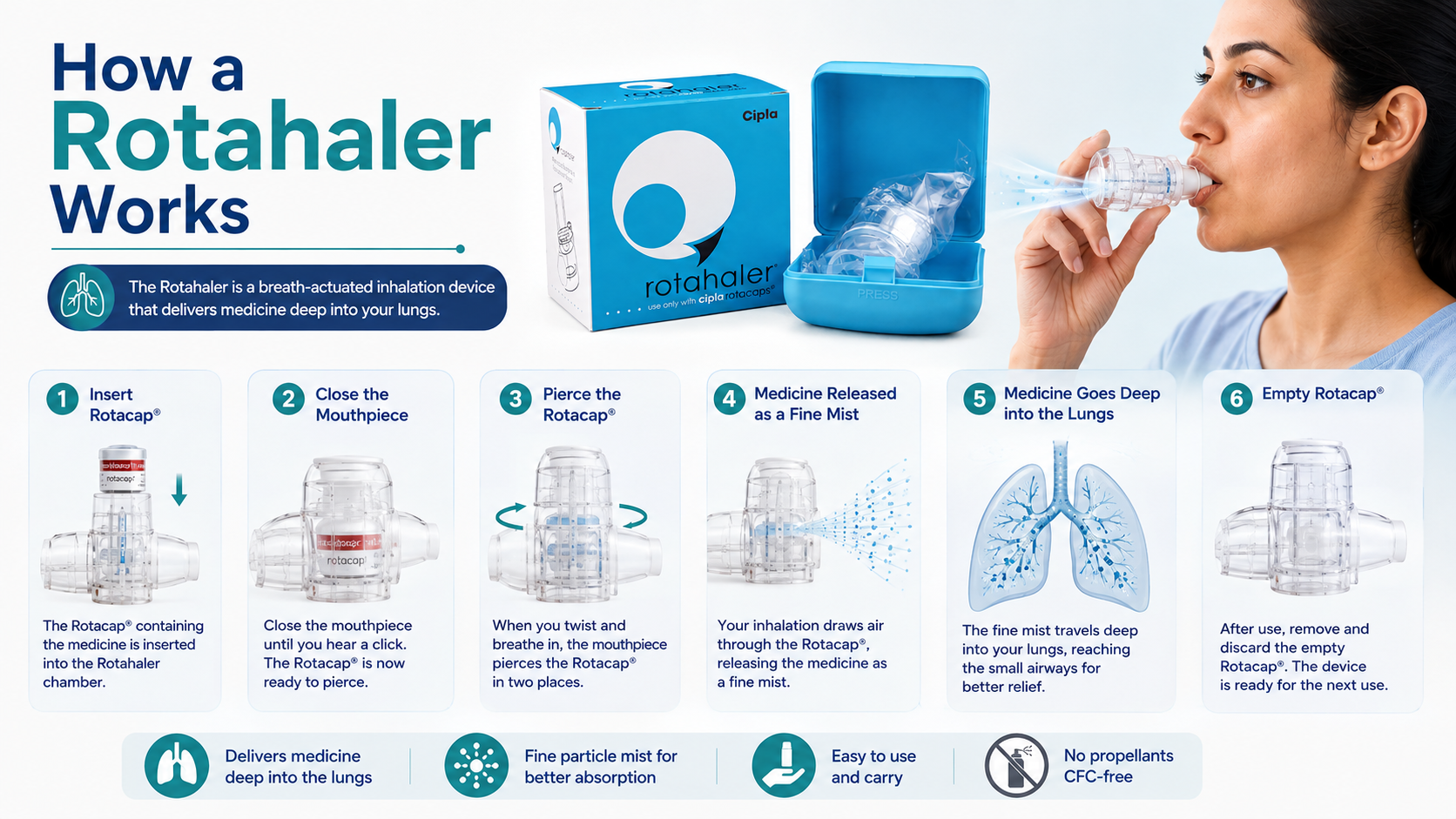
- A rotacap (medicated capsule) is placed into the chamber of the device.
- Twisting the two halves of the Rotahaler pierces the capsule, splitting it open inside the device.
- You breathe out fully, away from the device, then seal your lips around the mouthpiece.
- A fast, deep, forceful inhalation pulls the powdered medicine out of the pierced capsule and into your airways.
- You hold your breath for several seconds to let the powder settle in the lungs before breathing out slowly.
Because this entire process depends on your own inhalation to break up and carry the powder, a Rotahaler requires a reasonably strong, fast breath in to work properly — which is an important limitation in some patients, covered further below. Devices like the Respihaler Device and Octahaler Device work on this exact same breath-activated principle, just built by different manufacturers.
How an MDI Inhaler Works
- The canister is shaken to mix the medicine evenly with the propellant.
- The cap is removed and, ideally, the device is primed if it is new or has not been used in a while.
- You breathe out fully, then seal your lips around the mouthpiece.
- As you begin a slow, steady breath in, you press down firmly on the canister to release one measured puff.
- You continue inhaling slowly and deeply, then hold your breath for about 10 seconds.
Many patients — particularly children, older adults, and anyone who finds the press-and-breathe timing difficult — use a spacer device attached to the MDI. A spacer holds the puff of medicine in a chamber for a second or two, removing the need for split-second coordination and generally improving how much medicine actually reaches the lungs rather than the throat. Reliever inhalers such as Asthalin 100 Mcg Inhaler work this way, as do combination inhalers like Duolin Inhaler 50 Mcg + 20 Mcg.
Rotahaler vs Inhaler: Key Differences
| Feature | Rotahaler (DPI) | MDI Inhaler |
|---|---|---|
| Medicine form | Dry powder, in individual capsules | Pressurised liquid mist |
| Propellant | None — breath-activated | Yes, propellant gas |
| Coordination needed | Low — breathe in triggers the dose | High — press and breathe together |
| Breath required | Fast, forceful inhalation | Slow, steady inhalation |
| Loading | A fresh capsule inserted before each use | Pre-loaded canister, many doses inside |
| Best suited for | Patients who struggle with press-and-breathe timing, and who can inhale forcefully | Patients who can coordinate pressing and breathing, or who use a spacer |
| Portability | Compact, no propellant to run low on suddenly | Compact, but canister empties gradually and can run out without warning |
| Typical use | Bronchodilators delivered via rotacaps | Bronchodilators and steroid combinations |
Devices Similar to the Rotahaler
The Rotahaler is not the only capsule-based dry powder device on the market. Several other brands work on the same basic principle — pierce a capsule, inhale forcefully — with small differences in design. The Revolizer Device, for instance, is a Cipla design built specifically for Rotacaps, with a transparent chamber so you can visually confirm the dose has actually been released. Innohaler Inhaler and Lupihaler Inhaler are two more examples from Alkem and Lupin respectively, both using the same capsule-based approach.
These devices are generally brand-specific to the capsules they are designed for — a Revolizer is built for Rotacaps, while a Respihaler or Aerospin is built for Respicaps. Always use the exact capsule brand your device and prescription call for, rather than assuming any capsule fits any device.
Common MDI Inhalers
Standard pressurised inhalers remain the most widely used respiratory devices, and the range varies by what medicine they deliver. Seroflo Inhaler 25 Mcg + 250 Mcg is a good example of a combination inhaler, pairing a long-acting bronchodilator with an inhaled steroid for ongoing control, while a plain Cipla Asthma Inhaler is closer to a reliever.
Reliever inhalers and controller or combination inhalers are used very differently — relievers are for symptom flare-ups, while combination inhalers are usually taken on a regular schedule to keep symptoms from starting in the first place. Your prescription will specify which category your device falls into and how often to use it.
How to Use a Rotahaler Correctly

- Remove the mouthpiece cap and hold the Rotahaler Device upright.
- Twist the device open and insert one Ipravent Rotacap into the round hole in the wheel.
- Twist the device fully in the opposite direction to slide the capsule into position and pierce it — you should hear or feel it click.
- Breathe out fully, away from the mouthpiece, emptying your lungs as much as comfortable.
- Place the mouthpiece between your teeth and seal your lips around it. Keep the device level, not tilted, so the pierced capsule stays in place.
- Tilt your head back very slightly and inhale as fast and as deeply as you can in one continuous breath — this is the opposite of the slow inhale used with an MDI.
- Hold your breath for 5 to 10 seconds before breathing out slowly.
- Check the capsule shell — if powder remains, repeat the inhalation before discarding it.
- Remove and dispose of the empty capsule shell, then close and store the device.
How to Use an MDI Inhaler Correctly
- Remove the cap and shake the inhaler well for several seconds.
- If it is a new inhaler or has not been used in over a week, prime it with one or two test sprays into the air first, away from your face.
- Breathe out fully, away from the device.
- Seal your lips around the mouthpiece, or attach a spacer if you are using one.
- Begin a slow, steady breath in, and press down on the canister once, right at the start of that breath.
- Continue inhaling slowly and as deeply as you can.
- Hold your breath for about 10 seconds, then breathe out slowly.
- If a second puff is prescribed, wait about 30 to 60 seconds before repeating.
- Rinse your mouth with water after using a steroid-containing inhaler, to reduce the risk of oral thrush and hoarseness.
Pros and Cons of Each
Rotahaler (dry powder device)
- Pro: No coordination needed between pressing and breathing
- Pro: No propellant to run out mid-dose without warning
- Pro: Easy to visually confirm the capsule is empty after use
- Con: Requires a fast, forceful inhalation, which can be difficult for young children, frail or elderly patients, or anyone mid-severe-attack with limited lung capacity
- Con: A fresh capsule is needed for every single dose, which is less convenient than a pre-loaded canister
- Con: Humidity can affect the powder if capsules are not stored and handled carefully
MDI Inhaler
- Pro: Multiple doses pre-loaded in one canister, no capsule handling
- Pro: Works with a gentle, slow inhalation, suitable for people who cannot inhale forcefully
- Pro: Can be paired with a spacer for very young children or anyone who struggles with coordination
- Con: Requires accurate timing between the press and the breath, unless a spacer is used
- Con: The canister can run low without an obvious external sign, unless it has a dose counter
- Con: Cold propellant hitting the back of the throat sometimes triggers a reflex cough that cuts the inhalation short
Which One Is Right for You?
The right device depends far more on your ability to generate a fast, forceful breath than on personal preference alone:
- Good candidates for a Rotahaler or similar DPI: older children and adults with reasonable lung capacity who find press-and-breathe coordination difficult
- Better suited to an MDI, ideally with a spacer: very young children, frail or elderly patients, anyone with significantly reduced lung function, and anyone in the middle of a severe asthma attack — since a weak, fast breath cannot pull enough powder out of a DPI capsule
- During a severe flare-up: an MDI with a spacer is generally the more reliable choice, precisely because it does not depend on a strong inhalation the way a Rotahaler does
This is ultimately a decision for your doctor or pulmonologist, made alongside a demonstration of your actual inhaler technique — not something to switch on your own. If a fast, forceful inhale genuinely is not achievable for you, devices like the Aerospin Dry Powder Inhaler Device will not work any better than a Rotahaler — the limitation is the technique, not the specific brand of DPI.
Common Mistakes to Avoid
- Inhaling slowly from a Rotahaler. This is the single most common error — a DPI needs a fast, forceful breath, the opposite of MDI technique, and mixing the two up wastes most of the dose.
- Pressing an MDI canister before or after starting to breathe in, rather than at the exact same moment.
- Not shaking an MDI canister before use.
- Tilting a loaded Rotahaler sideways or upside down, which can dislodge the pierced capsule before you inhale.
- Reusing an empty rotacap shell or leaving capsules exposed to humidity before use.
- Not rinsing the mouth after a steroid inhaler, increasing the risk of oral thrush.
- Not checking a dose counter or capsule supply, and running out mid-treatment.
Cleaning and Storage
- Wipe the mouthpiece of a Rotahaler with a dry cloth; avoid washing it with water, since trapped moisture can affect capsule performance.
- Clean an MDI mouthpiece weekly with a dry cloth, or as directed on the label — most canisters should not be submerged in water.
- Store rotacaps in a cool, dry place, in their original blister packaging until the moment of use — do not pre-load capsules in advance.
- Keep MDI canisters away from direct heat and never puncture, burn, or store them near an open flame, as they are pressurised.
- Check expiry dates on both capsules and canisters, and replace devices that are cracked or damaged.
Frequently Asked Questions
1. Is a Rotahaler better than a regular inhaler?
Neither is universally “better” — they suit different patients. A Rotahaler works well for people who struggle to coordinate pressing and breathing but can manage a fast, forceful inhale. An MDI, especially with a spacer, suits people who cannot inhale forcefully, including young children and frail or elderly patients.
2. Can I use any rotacap in any dry powder device?
No. Devices like the Rotahaler, Revolizer, Respihaler, and Aerospin are generally designed for specific capsule brands. Always use the capsule type your prescription and device specify.
3. Why does my Rotahaler feel like nothing happened?
If you inhale too gently, the capsule may not empty properly. Check the used shell — if powder remains inside, your breath was not forceful enough, and the technique needs adjusting.
4. Do I need a spacer with my MDI inhaler?
Not always, but a spacer is recommended for young children, older adults, and anyone who finds it hard to coordinate the press-and-breathe timing. It also reduces medicine landing in the mouth and throat.
5. How do I know when my MDI inhaler is empty?
Inhalers with a built-in dose counter make this straightforward. Without one, track the number of doses used against the labelled total, since the canister can continue to spray propellant with little or no medicine left inside.
6. Can children use a Rotahaler?
It depends on the child’s lung capacity and ability to generate a fast, forceful breath, which usually rules out very young children. Many paediatricians prefer an MDI with a spacer and mask for younger patients.
7. Is a dry powder inhaler safe during a severe asthma attack?
Generally, an MDI with a spacer is preferred during a severe attack, since a weak or fast, shallow breath during an attack may not be forceful enough to pull the full dose out of a DPI capsule.
8. Why does my inhaler taste different from my Rotahaler?
MDI inhalers use a propellant that often has a distinct taste or cold sensation on the back of the throat. A Rotahaler delivers dry powder with no propellant, so it tends to taste more like the medicine itself.
9. Can I switch between a Rotahaler and an MDI on my own?
No — the two require opposite breathing techniques (fast and forceful versus slow and steady), and switching without guidance can significantly reduce how much medicine actually reaches your lungs. Any device change should go through your prescribing doctor.
10. How often should I replace my Rotahaler device?
The device itself is reusable and does not need routine replacement unless it becomes cracked, damaged, or difficult to twist and load properly. Check the manufacturer’s guidance on your specific device for a recommended replacement interval.
Conclusion
A Rotahaler and a standard MDI inhaler both get respiratory medicine into your lungs, but they get there in almost opposite ways — one needs a fast, forceful breath and no coordination, the other needs gentle, steady breathing perfectly timed with a press of the canister. Using the wrong technique on either device is one of the most common, and most fixable, reasons asthma and COPD treatment does not work as well as it should.
If you are not confident your technique is correct on whichever device you have been prescribed, ask your pharmacist or doctor for a hands-on demonstration — it takes a few minutes and is one of the most useful things you can do for your treatment to actually work.
Browse respiratory devices and inhalers at PMC Herbals. Prescription required for all inhalers and rotacaps.
Medical Disclaimer
This article is intended for general educational and informational purposes only. It is not medical advice, and it is not a substitute for consultation, diagnosis, or treatment by a qualified healthcare professional.
Rotahalers, dry powder devices, rotacaps, and MDI inhalers are prescription medical devices and medicines. Do not start, stop, or switch between respiratory devices without your prescriber’s guidance, and always follow the specific instructions provided with your device and medication, as technique can vary between brands.
If you experience worsening breathlessness, a severe asthma attack, or symptoms that do not respond to your reliever inhaler, seek medical attention immediately.
PMC Herbals does not dispense prescription medicines or devices without a valid prescription and does not accept liability for decisions made solely on the basis of this content.