










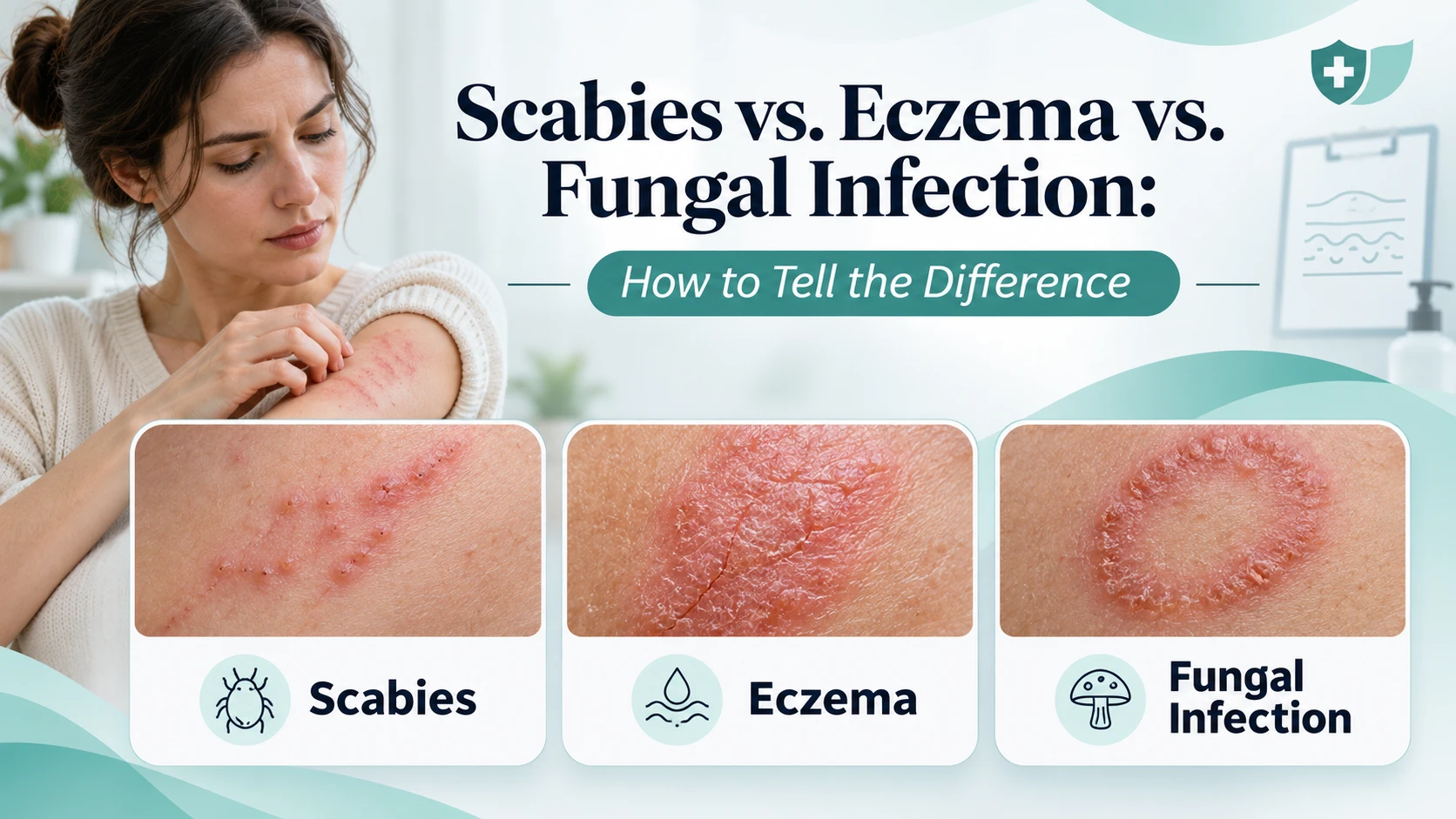
Skin rashes can be deeply frustrating. When an itchy, red patch appears, it is easy to assume it is just a dry patch or a mild allergy. However, scabies, eczema, and fungal infections require entirely different medical approaches — treating a fungal infection with an eczema steroid cream, for example, can actually make the condition much worse.
Knowing how to spot the key differences between these three common skin conditions can save you weeks of discomfort and help you reach for the right treatment the first time.
1. Scabies: The Intensely Itchy Burrower
Scabies is not an allergy or an infection; it is a skin infestation caused by tiny microscopic mites called Sarcoptes scabiei that burrow into the upper layer of the skin to live and lay eggs.
- Primary Symptom: Severe, relentless itching, which typically worsens dramatically at night.
- Appearance & Patterns: Look for tiny, thin, raised, irregular burrows (grayish-white or skin-colored lines) on the skin, often accompanied by small pimple-like bumps or blisters.
- Common Locations: Between the fingers, inside the wrist creases, elbows, armpits, waistline, around the buttocks, and shoulder blades. In infants, it can also affect the head, face, neck, palms, and soles.
- Contagiousness: Highly contagious — it spreads easily through direct, prolonged skin-to-skin contact with an infected person, and occasionally through shared bedding, towels, or clothing.
Prescription scabicide creams such as Zeroscab Cream (permethrin) are the standard first-line treatment, often alongside oral medication for more widespread cases.
2. Eczema (Atopic Dermatitis): The Chronic Inflammatory Patch
Eczema is a chronic inflammatory skin condition linked to immune system activation, genetics, and environmental triggers. It is not contagious.
- Primary Symptom: Persistent itching, dry skin, and localized inflammation that tends to flare up and recede over time.
- Appearance & Patterns: Red to brownish-gray patches. During flare-ups, the skin can become raw, sensitive, swollen, or covered in tiny fluid-filled blisters that may ooze and crust over if scratched.
- Common Locations: Frequently appears in skin creases, such as the inside of the elbows, behind the knees, on the neck, wrists, ankles, and hands. In babies, it often appears on the cheeks and forehead.
- Triggers: Stress, dry winter air, harsh soaps, synthetic fabrics, detergents, and specific allergens.
Topical treatments like Mupizer F Ointment are often used for inflamed, irritated patches, alongside daily moisturizing and trigger avoidance.
3. Fungal Infections (Ringworm): The Ring-Shaped Scaler
Fungal infections, such as ringworm (tinea corporis) or athlete’s foot, are caused by dermatophytes — parasitic fungi that feed on the keratin in dead skin, hair, and nails.
- Primary Symptom: Itchy, scaly, or ring-shaped discomfort that is usually well-demarcated from healthy skin.
- Appearance & Patterns: Distinct circular or oval patches with raised, red, scaly borders, while the center often looks relatively clear or normal (hence the name “ringworm,” though no worms are involved).
- Common Locations: Varies by type. Ringworm can appear on the torso, limbs, or face. Athlete’s foot occurs between the toes, while jock itch affects the groin area.
- Contagiousness: Contagious — it spreads through direct contact with an infected person, infected pets, or contaminated surfaces like gym floors, locker rooms, and shared towels.
Topical antifungals such as Ring Guard Cream and Canesten Anti-Fungal Cream are typically used to clear ringworm and related skin infections.
Comparison At-a-Glance
| Feature | Scabies | Eczema | Fungal Infection (Ringworm) |
|---|---|---|---|
| Cause | Microscopic mites (Sarcoptes scabiei) | Immune response, genetics, environmental triggers | Dermatophyte fungi |
| Contagious? | Yes (high skin-to-skin transmission) | No | Yes (direct contact or shared items) |
| Primary Shape | Linear burrows and scattered bumps | Irregular, dry, inflamed patches | Distinct circular/ring shape with raised edges |
| Peak Itch Time | Worse at night | Varies, often triggered by sweat or dry air | Constant, localized itching or burning |
| Typical Treatment | Prescription scabicide creams (permethrin) or oral medications (ivermectin) | Moisturizers, topical corticosteroids, trigger avoidance | Topical or oral antifungal medications |
Key Takeaways: When to See a Doctor
Because treatments differ so vastly — using an antifungal for scabies will do nothing, and using a steroid cream on a fungal infection can cause it to spread rapidly — an accurate professional diagnosis is essential.
Consult a dermatologist or healthcare provider if:
- Your rash persists for more than a few days without improvement.
- The itching keeps you awake at night or disrupts your daily life.
- Other members of your household or close contacts are developing similar itchy rashes.
Once you have a confirmed diagnosis, browse our full range of skin disorder treatments to find the right option.
Frequently Asked Questions
Can you have scabies and eczema at the same time?
Yes. Scratching from scabies can irritate the skin and trigger an eczema flare-up in people who are already prone to it, which is why a doctor sometimes needs to treat both conditions together.
How can I tell ringworm from eczema at home?
Ringworm usually forms a distinct ring with a raised, scaly border and a clearer center, while eczema patches are irregular in shape and tend to appear in skin folds like the elbows and knees.
Does scabies go away on its own without treatment?
No. Scabies mites do not clear up without treatment and will continue to spread on the body and to close contacts until a proper scabicide is used.
Can using eczema cream on a fungal infection make it worse?
Yes. Steroid creams meant for eczema can suppress the local immune response and allow a fungal infection to spread faster and become harder to treat.
Why does scabies itch more at night?
Mite activity increases with body warmth, and warmth builds up under blankets at night, which is why the itching from scabies tends to feel most intense after you lie down.
Legal Disclaimer
This article is for general educational purposes only and is not a substitute for professional medical advice, diagnosis, or treatment. Always consult a qualified healthcare provider or dermatologist about your specific symptoms before starting any treatment. If your rash is severe, spreading rapidly, or accompanied by fever, seek medical care promptly.