










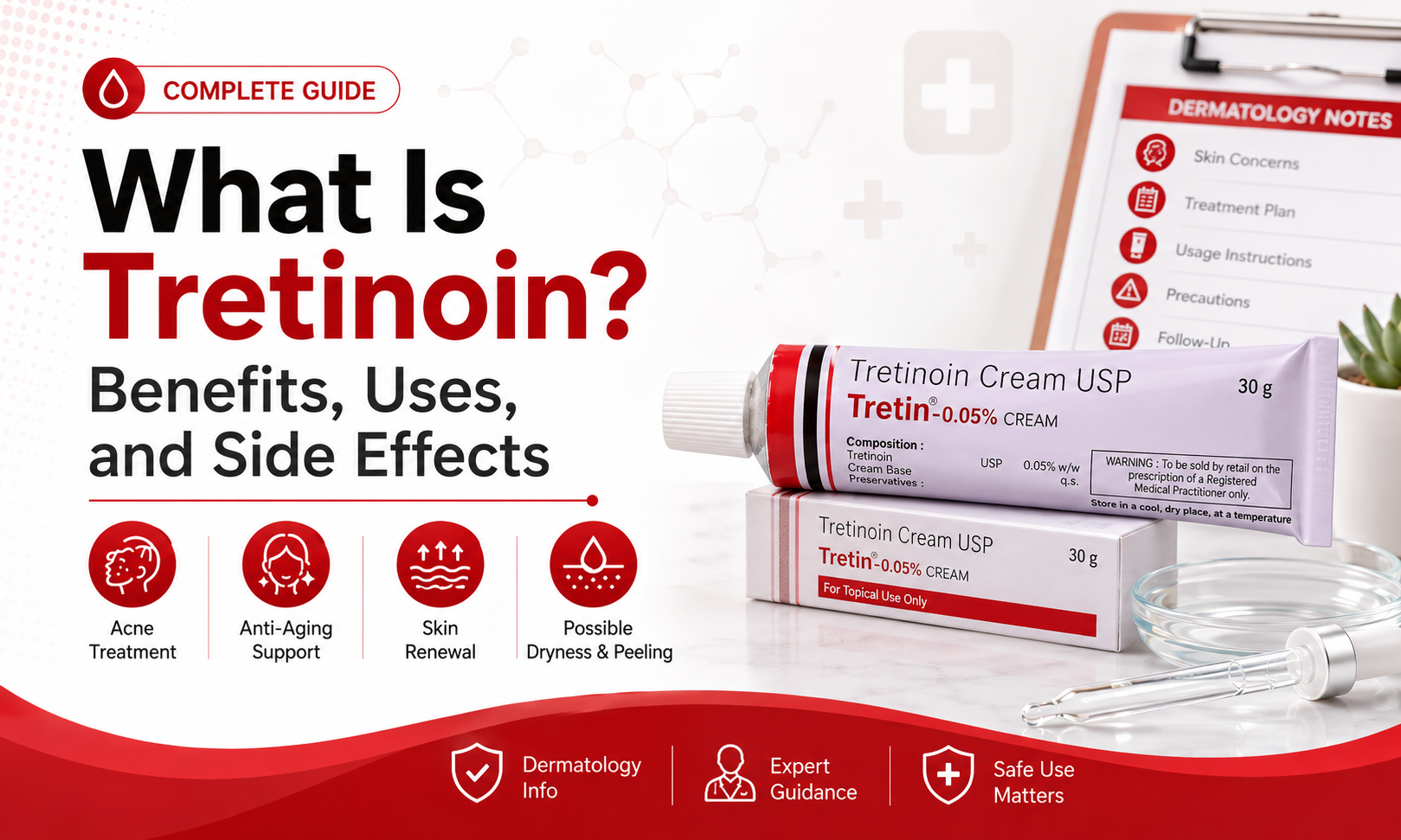
If you have spent any time reading about acne or anti-ageing skincare, you have almost certainly run into the word tretinoin. It shows up in dermatologist interviews, in “my skin transformation” videos, and on the prescription pad after a clinic visit for stubborn breakouts.
But tretinoin is not a trend. It has been studied in humans since the late 1960s, was approved by the US FDA for acne in 1971, and is one of the very few skincare ingredients with decades of published clinical data behind it. Dermatologists often call it the gold standard topical treatment — not because it is new or exciting, but because it keeps working.
Here is the catch: tretinoin is a prescription medicine, not a cosmetic. Used correctly, it can clear acne, soften fine lines, fade dark patches and genuinely improve skin texture. Used carelessly, it can leave your face red, flaking and irritated for weeks — which is exactly why so many people give up on it in the first month.
This guide walks you through what tretinoin actually is, how it works inside your skin, who it helps, how to apply it without wrecking your barrier, and the side effects and precautions you should know before you start. Everything here is written in plain English, and it is meant to help you have a better conversation with your doctor — not to replace one.
What Is Tretinoin?
Tretinoin is a prescription-strength vitamin A derivative — chemically known as all-trans retinoic acid, or ATRA. It belongs to a family of medicines called retinoids, which are compounds related to vitamin A that influence how skin cells grow, mature and shed.
The important thing to understand is that tretinoin is the active form of vitamin A. Your skin does not need to convert it into anything else. It arrives ready to work, which is precisely why it is both more effective and more irritating than the over-the-counter alternatives sitting on pharmacy shelves.
Tretinoin comes in several topical formats, and the format matters more than most people realise:
| Format | Typical Strengths | Best Suited For |
|---|---|---|
| Cream | 0.025%, 0.05%, 0.1% | Dry, normal or sensitive skin — more emollient, gentler |
| Gel | 0.01%, 0.025%, 0.05% | Oily and acne-prone skin — lighter, faster absorbing, can be drying |
| Microsphere gel | 0.04% – 0.1% | Slow, controlled release into the follicle; usually less irritating |
| Lotion / emollient cream | 0.05% | Mature or photodamaged skin; anti-ageing use |
There is also an oral form of tretinoin, but it is a completely different clinical animal. Oral ATRA is used in hospitals to treat acute promyelocytic leukaemia (a type of blood cancer) under strict specialist supervision. It has nothing to do with skincare, and it is never prescribed for acne. When this article says “tretinoin,” it means the topical cream or gel you apply to your skin.
In India and most other countries, topical tretinoin is a Schedule H, prescription-only medicine. If a website is selling it to you with no questions asked, that is a warning sign about the seller, not a convenience.
How Does Tretinoin Work?
Most skincare ingredients work on the surface. Tretinoin works at the level of your genes — and that sounds dramatic until you see what it actually does.
When you apply tretinoin, it passes into the skin cells and binds to retinoic acid receptors (RAR-alpha, RAR-beta and RAR-gamma) inside the cell nucleus. Once bound, these receptors act like switches, turning certain genes up and others down. The result is a set of changes that unfold over weeks and months.
1. It speeds up cell turnover
Normally your skin takes roughly 28 days to replace its outer layer. Tretinoin accelerates that cycle, pushing older, damaged and pigmented cells to the surface faster so fresher cells replace them.
2. It stops pores from clogging in the first place
This is the part that matters most for acne. Skin cells inside the pore lining are supposed to shed and wash away. In acne-prone skin, they stick together and plug the follicle, forming a microcomedone — the invisible seed of every future pimple. Tretinoin loosens that stickiness, so the plug never forms. That is why tretinoin is a preventive acne treatment, not a spot treatment.
3. It clears out existing blackheads and whiteheads
By unplugging follicles, it pushes out the comedones already sitting in your pores. This is also why some people see things get worse before they get better.
4. It rebuilds collagen
Tretinoin stimulates the production of type I and type III collagen in the dermis and suppresses the enzymes that break collagen down. Over months, this thickens the dermis and softens fine lines. The effect is slow — measured in seasons, not weeks.
5. It evens out pigment
It disperses clumped melanin granules and speeds the removal of pigmented cells, which is why it helps with dark spots, melasma and post-acne marks.
6. It normalises abnormal cells
In sun-damaged skin, tretinoin encourages irregular surface cells to behave more like healthy ones — one reason dermatologists use it for photodamage and rough, weather-beaten skin.
The honest summary: tretinoin does not resurface your face overnight. It gradually retrains how your skin behaves.
Benefits of Tretinoin
Here is what tretinoin realistically delivers, and roughly when.
Clears and prevents acne
This is its best-documented benefit. Tretinoin works on comedonal acne (blackheads and whiteheads) and inflammatory acne (papules and pustules) alike. It is frequently combined with a topical or oral antibiotic or with benzoyl peroxide for moderate cases, and it is one of the most commonly used maintenance treatments after a course of isotretinoin. Expect meaningful improvement at 8 to 12 weeks, not two.
Softens fine lines and wrinkles
The 0.05% emollient cream formulation is specifically approved for fine facial wrinkles associated with sun damage. Studies consistently show improvement in fine lines, skin roughness and mottled pigmentation with continued use over 24 weeks or longer.
Fades dark spots and uneven tone
Post-inflammatory hyperpigmentation — those brown marks acne leaves behind — responds well to tretinoin. It is also a standard component of dermatologist-prescribed depigmenting combinations used for melasma.
Smooths texture and refines pores
Tretinoin does not shrink pore size (pore diameter is largely genetic), but by keeping pores clear of debris it makes them look considerably smaller and the skin surface noticeably smoother.
Improves the look of sun damage
Rough patches, sallow yellowish tone and the general weathered look of chronic sun exposure all tend to improve with sustained use.
It is inexpensive and evidence-backed
Compared with in-clinic procedures or premium cosmetic serums, a tube of tretinoin is remarkably affordable — and it has fifty years of peer-reviewed data behind it, which almost no cosmetic ingredient can claim.
Explore dermatologist-recommended skincare: Browse the full Skin Care range at PMC Herbals for cleansers, moisturisers and sunscreens that pair well with a retinoid routine.
Common Uses of Tretinoin
Approved (on-label) uses
- Acne vulgaris — the primary indication for tretinoin cream and gel.
- Fine facial wrinkles, mottled hyperpigmentation and rough skin caused by chronic sun exposure — for the 0.05% emollient cream, used as part of a programme that includes sun avoidance and daily sunscreen.
- Acute promyelocytic leukaemia — oral tretinoin only, in a hospital oncology setting.
Off-label uses your dermatologist may consider
- Melasma, usually alongside hydroquinone and a mild topical steroid
- Post-inflammatory hyperpigmentation after acne, injury or insect bites
- Keratosis pilaris — the rough “chicken skin” bumps on upper arms and thighs
- Stretch marks (striae) — most effective on early, still-red marks; limited benefit on old white ones
- Photoageing and actinic damage, including as an adjunct in managing actinic keratoses
- Enhancing penetration of other topical treatments by thinning the outer dead-cell layer
Off-label does not mean unsafe. It simply means the specific use has not gone through a formal regulatory approval process. These uses are common in dermatology practice and supported by published evidence, but they need a doctor’s judgement.
How to Apply Tretinoin Correctly
Most tretinoin failures are application failures. Get this part right and you avoid the majority of problems.
Step 1 — Use it at night, always. Tretinoin is degraded by sunlight and it makes skin more sun-sensitive. Night application is standard.
Step 2 — Cleanse gently and wait. Wash with a mild, non-foaming cleanser. Then wait 20 to 30 minutes until your skin is completely dry. Applying tretinoin to damp skin dramatically increases absorption — and irritation. This single step prevents more redness than any other.
Step 3 — Use a pea-sized amount. That is the whole face. Not per cheek. Not a generous squeeze. A pea. Dot it on the forehead, both cheeks, chin and nose, then spread thinly.
Step 4 — Avoid the danger zones. Stay away from the eyelids, the corners of the mouth, the creases beside the nostrils and any broken or inflamed skin. These areas are thin and irritate easily. Some people apply a thin layer of plain moisturiser to these zones first as a buffer.
Step 5 — Moisturise. Apply a bland, fragrance-free moisturiser afterwards — or before, if your skin is sensitive (the sandwich method: moisturiser, tretinoin, moisturiser). Buffering reduces irritation without meaningfully reducing effectiveness for most people.
Step 6 — Sunscreen every single morning. Broad-spectrum SPF 30 or higher, reapplied if you are outdoors. This is not optional advice. Without it you can undo the pigmentation benefits entirely and increase your risk of burning.
Starting schedule for beginners
| Weeks | Frequency |
|---|---|
| Weeks 1 to 2 | 2 nights per week |
| Weeks 3 to 4 | Every alternate night |
| Weeks 5 to 6 | 5 nights per week |
| Week 7 onward | Nightly, if your skin tolerates it |
If your skin gets red, tight or flaky, drop back a step for a week. There is no prize for going fast. Nightly use is a goal, not a requirement — plenty of people do beautifully on three or four nights a week long term.
Side Effects of Tretinoin
Nearly everyone experiences some irritation in the first six to eight weeks. Dermatologists call this retinisation — the adjustment period. It is expected, and for most people it settles.
Common side effects (usually temporary)
- Redness and warmth
- Dryness, tightness and flaking or peeling
- Mild burning or stinging right after application
- Increased sensitivity to sun, wind and cold
- Temporary darkening or lightening of skin in treated areas
- Skin feeling papery or fragile
The purge
Around weeks 2 to 6, many people see a temporary flare of breakouts. This is not the medicine failing. Tretinoin is accelerating microcomedones that were already forming under the surface, so a few weeks of pre-existing acne surfaces all at once. It typically settles by week 8 to 12. Reduce frequency if needed, but resist the urge to quit — this is the single most common point at which people abandon treatment right before it starts working.
Less common side effects
- Contact dermatitis (itchy, scaly, well-defined patches)
- Blistering or crusting from overuse
- Worsening of underlying eczema or rosacea
When to stop and call a doctor
- Severe swelling, blistering or oozing
- Hives, tightness in the throat, or difficulty breathing (rare allergic reaction — seek emergency care)
- Pain that does not settle, or skin that is breaking down
- Signs of infection in treated skin
Most side effects are dose-related. Less product, less often, with more moisturiser, solves most of them.
Who Should Avoid Tretinoin?
Tretinoin is not right for everyone. Avoid it, or use it only under close medical supervision, if you are:
- Pregnant, planning pregnancy, or breastfeeding. Oral retinoids are strongly teratogenic. Topical absorption is low, but most doctors advise stopping tretinoin during pregnancy and lactation as a precaution, and safer alternatives such as azelaic acid are usually preferred.
- Allergic to tretinoin, other retinoids, or any ingredient in the formulation, including fish-derived ingredients in some preparations if you have a fish allergy.
- Living with active eczema, rosacea or a severely compromised skin barrier. Tretinoin can flare all three.
- Currently sunburnt, or with broken, raw or wind-chapped skin. Wait until it has healed completely.
- Working long hours in direct sun with no realistic way to use sunscreen and protective clothing.
- Undergoing chemical peels, laser treatment, microdermabrasion or waxing on the treated area — pause tretinoin well before and after, as advised by your practitioner.
- A child under 12, unless specifically prescribed by a paediatric dermatologist.
If you have a history of skin cancer, are on photosensitising medication, or have any chronic skin condition, get individual advice before starting.
Precautions and Warnings
- Sun protection is part of the treatment, not an add-on. Tretinoin thins the outer dead-cell layer and increases UV sensitivity. Daily broad-spectrum SPF 30 or higher, hats and shade are essential — especially in Indian sun conditions.
- Do not overapply. More tretinoin does not equal faster results. It equals more irritation and, ironically, worse adherence.
- Do not use on wet skin.
- Skip the harsh extras. While on tretinoin, pause scrubs, cleansing brushes, alcohol-heavy toners, astringents, lime or medicated soaps and strong exfoliating acids unless your dermatologist has planned the combination.
- Expect cold-weather and air-conditioning flare-ups. Dry environments amplify peeling. Increase moisturiser rather than reducing your dose.
- Waxing is a real risk. Tretinoin-treated skin can tear during waxing or threading. Stop tretinoin for at least 5 to 7 days beforehand.
- Be patient with pigmentation. Dark spots often look slightly worse in the first month as surface cells shed, then improve steadily.
- Never share a prescription. What suits your friend’s oily skin may badly irritate yours.
- Keep away from children. Store out of reach and never let anyone else use your tube.
Drug Interactions
Topical tretinoin has very low systemic absorption, so classic drug-to-drug interactions are uncommon. The interactions that matter are mostly on the skin.
Use with caution on the same skin
| Product or Ingredient | Concern | Practical advice |
|---|---|---|
| Benzoyl peroxide | Can chemically degrade standard tretinoin and stacIngredient Concern Practicalks irritation | Use BPO in the morning, tretinoin at night, or use a stabilised combination product prescribed together |
| Salicylic, glycolic and lactic acid | Additive peeling and stinging | Alternate nights, or skip while retinising |
| Sulfur, resorcinol, medicated soaps | Strong combined drying effect | Avoid unless prescribed together |
| Alcohol-based toners and astringents | Barrier damage | Avoid |
| Physical scrubs, cleansing brushes | Micro-abrasion on fragile skin | Stop entirely |
| Vitamin C serums | Not dangerous, but can sting | Use vitamin C in the morning |
| Hair removal creams and wax | Skin tearing | Pause tretinoin 5 to 7 days before |
Medicines that increase sun sensitivity
Combining tretinoin with photosensitising drugs raises your risk of burning. These include tetracycline and doxycycline, fluoroquinolones, sulfonamides, thiazide diuretics and phenothiazines. Many acne patients are prescribed doxycycline with tretinoin — that is a normal, intentional combination, but it makes sun protection even more important.
Vitamin A supplements
Avoid high-dose vitamin A supplements while using retinoids unless your doctor has approved them.
Always give your doctor or pharmacist a complete list of everything you use, including cosmetics, ayurvedic preparations and supplements.
Tretinoin Dosage Guide
This is general reference information. Your prescription overrides anything below.
| Situation | Typical Starting Strength | Frequency |
|---|---|---|
| First-time user, sensitive or dry skin | Cream 0.025% | 2 to 3 nights a week, building slowly |
| Oily, acne-prone skin | Gel 0.025% | Alternate nights, building to nightly |
| Established user, stubborn acne | Cream or gel 0.05% | Nightly, as tolerated |
| Anti-ageing and photodamage | Emollient cream 0.05% | Nightly or alternate nights, long term |
| Severe or resistant acne | 0.1%, a specialist decision | Nightly, closely supervised |
Quantity per application: a pea-sized amount for the entire face. A standard 20 g tube used correctly should last roughly two to three months.
Missed a night? Simply resume the next night. Never double up to compensate.
How long until results?
- Acne: initial change at 4 to 6 weeks, clear benefit at 8 to 12 weeks
- Pigmentation and tone: 3 to 4 months
- Fine lines and texture: 6 to 12 months of consistent use
Tretinoin is maintenance therapy, not a course. Acne tends to return within a few months of stopping, and collagen benefits gradually fade. Most people who are happy with it stay on it, often at a reduced frequency.
Shop the range: View the Tretinoin product page and browse related Acne Treatment products at PMC Herbals. Prescription required.
Storage Instructions
- Store at room temperature, 20 to 25 degrees Celsius. Brief excursions to 15 to 30 degrees are acceptable.
- Keep away from direct sunlight. Tretinoin is light-sensitive and loses potency when exposed. Do not leave the tube on a sunny windowsill or bathroom shelf.
- Keep away from heat and humidity. A bedroom drawer is a better home than a steamy bathroom cabinet.
- Close the cap tightly after every use. Air and light are the two things that degrade it fastest.
- Do not freeze, and do not refrigerate unless the label specifically says so.
- Gel formulations are flammable. Keep away from open flame and do not smoke immediately after applying.
- Check the expiry date. Discard expired product; potency and stability are not reliable past that point.
- Keep out of reach of children and pets. Dispose of unused medicine through a pharmacy take-back scheme where available, not down the drain.
Tretinoin vs Retinol
Both are vitamin A derivatives, and they sound similar enough that people use the words interchangeably. They are not the same thing.
The key difference is conversion. Retinol has to be converted by enzymes in your skin — first to retinaldehyde, then to retinoic acid — before it does anything. Each conversion step loses potency. Tretinoin is retinoic acid, so it skips the queue entirely.
| Feature | Tretinoin | Retinol |
|---|---|---|
| Chemical form | Retinoic acid (active) | Retinol (needs 2-step conversion) |
| Availability | Prescription only | Over-the-counter cosmetic |
| Relative strength | Roughly 10 to 20 times stronger | Milder |
| Speed of results | Acne: 8 to 12 weeks | Acne: 3 to 6 months, if at all |
| Irritation level | Moderate to high initially | Low to mild |
| Regulatory status | Approved drug with clinical trial data | Cosmetic ingredient, variable quality |
| Best for | Moderate acne, real photoageing, pigmentation | Beginners, sensitive skin, prevention, maintenance |
| Medical supervision | Required | Not required |
| Cost | Low (generic) | Varies widely, often higher |
Which should you choose? If your acne is mild and you have never used a retinoid, retinol is a sensible starting point. If you have persistent acne, visible sun damage, or you have used retinol for six months and seen nothing, tretinoin is the logical next conversation to have with a dermatologist.
Also worth knowing: adapalene sits between the two. It is a synthetic retinoid, available over the counter in many countries, and it is generally better tolerated than tretinoin while being considerably more effective than retinol.
Tips for Best Results
- Simplify everything else. During the first two months, run the most boring routine of your life: gentle cleanser, tretinoin, moisturiser, sunscreen. Add nothing new. If your skin reacts, you will know exactly what caused it.
- Moisturise more than you think you need to. Look for ceramides, glycerin, hyaluronic acid, squalane or panthenol. A fragrance-free, barrier-repairing cream applied morning and night makes the entire experience easier.
- Buffer if you are sensitive. Moisturiser first, tretinoin second. The slight reduction in intensity is a fair trade for actually sticking with it.
- Do not treat flaking with scrubbing. Peeling skin is fragile skin. Scrubbing it makes the next round worse. Moisturise and let it shed on its own.
- Track your skin, not your feelings. Take a photo in the same light on day one, then monthly. Progress this slow is invisible day to day and obvious across three months.
- Sunscreen is the multiplier. Consistent SPF makes tretinoin work better on pigmentation and protects the collagen you are building. Skipping it works directly against the treatment.
- Give it a full 12 weeks before judging. Almost nobody who quits at week five knows whether tretinoin would have worked for them.
- Adjust with the seasons. Reduce frequency in dry winter months, increase again when humidity returns.
- Keep the same product. Different formulations and bases behave differently. Once your skin adapts to one, changing brands can restart the irritation clock.
- Check in with your dermatologist at 3 months. That is the right moment to decide whether to increase strength, add a second treatment, or change course.
Frequently Asked Questions
1. How long does tretinoin take to work?
For acne, most people see initial improvement in 4 to 6 weeks and clear results by 8 to 12 weeks. For fine lines, texture and sun damage, expect 3 to 6 months for visible change and up to a year for the full effect. It is genuinely a slow medicine.
2. Is the tretinoin purge real, and should I stop?
It is real. Around weeks 2 to 6 you may break out more as underlying microcomedones surface. It usually settles by week 8 to 12. Do not stop — reduce your frequency to alternate nights if it is severe, and speak to your doctor if it is still worsening after 12 weeks.
3. Can I use tretinoin every day?
Eventually, yes, if your skin tolerates it. Start at 2 to 3 nights a week and build up over 6 to 8 weeks. Nightly use is the goal for many people, but three to four nights a week long term still delivers real results and is far better than quitting.
4. Can I use tretinoin under my eyes?
Not without guidance. The skin there is very thin and irritates easily. Some dermatologists do prescribe careful use around the eye area for fine lines, but this should be a specific instruction from your doctor, not something you decide on your own.
5. Can I use tretinoin during pregnancy?
No, not without your obstetrician’s approval. Although topical absorption is low, retinoids as a class are associated with birth defects, and most doctors advise stopping tretinoin during pregnancy and breastfeeding. Azelaic acid is a commonly recommended alternative.
6. Do I really need sunscreen with tretinoin?
Yes, without exception. Tretinoin increases sun sensitivity and is itself broken down by UV light. Daily broad-spectrum SPF 30 or higher protects your skin and protects your results.
7. What happens if I stop using tretinoin?
Acne usually returns within a few months as pore-clogging resumes. Collagen and pigmentation benefits fade gradually over a longer period. Tretinoin manages skin conditions rather than curing them, which is why it is generally used as long-term maintenance.
8. Can I use tretinoin with niacinamide, vitamin C or hyaluronic acid?
Yes. Niacinamide and hyaluronic acid pair well with tretinoin and can actually reduce irritation. Vitamin C is best used in the morning to avoid stinging. The ingredients to be careful with are exfoliating acids, benzoyl peroxide and physical scrubs.
9. Is tretinoin available without a prescription?
No. Topical tretinoin is a prescription medicine in India and most countries. A consultation matters here — the right strength and format for oily skin is very different from what suits dry or sensitive skin.
10. Tretinoin or adapalene, which is better for a beginner?
Adapalene is gentler and available over the counter in many places, making it a good entry point. Tretinoin is stronger and works faster, particularly for photoageing and pigmentation, where adapalene has less evidence. Your dermatologist can match the choice to your skin type and goal.
Conclusion
Tretinoin has stayed relevant for more than fifty years for a simple reason: it works, and we can prove it works. It clears acne by preventing pores from clogging in the first place, it rebuilds collagen over months, and it steadily evens out tone and texture.
But it rewards patience and punishes impatience. The people who get great results are not the ones who apply the most. They are the ones who start slowly, moisturise generously, wear sunscreen every day, and keep going through the awkward six weeks in the middle.
If you are dealing with acne that has not responded to over-the-counter products, or you are starting to notice sun damage and fine lines, tretinoin is worth discussing with a qualified dermatologist. They can pick the right strength and formulation for your skin, plan the combination with anything else you are using, and check in on your progress.
Start low. Go slow. Protect your skin from the sun. Give it three months.
Explore dermatologist-backed skincare, acne treatments and sun protection at PMC Herbals.
Medical Disclaimer
This article is intended for general educational and informational purposes only. It is not medical advice, and it is not a substitute for consultation, diagnosis or treatment by a qualified healthcare professional.
Tretinoin is a prescription medicine. Do not start, stop, or change the dose or frequency of any medication based on the information in this article. Always consult a registered medical practitioner or dermatologist who can assess your individual skin type, medical history, current medications and specific condition before beginning treatment.
If you experience severe irritation, blistering, swelling, difficulty breathing or any other serious reaction, stop use immediately and seek medical attention.
PMC Herbals does not dispense prescription medicines without a valid prescription and does not accept liability for decisions made solely on the basis of this content.