










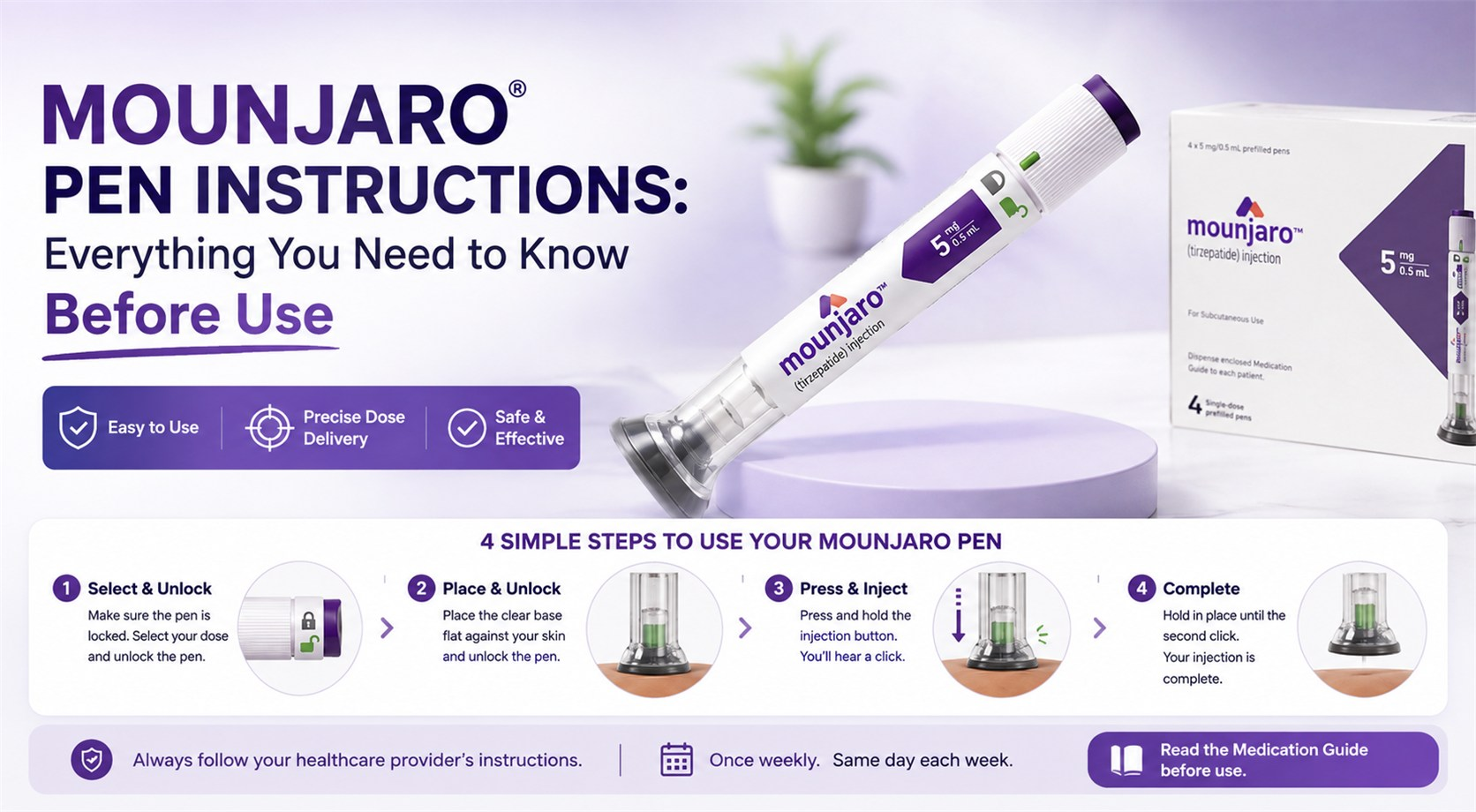
Starting a weekly injection at home is a strange feeling. Most people have taken tablets before, but a pen you press into your own skin is a different kind of step — and the leaflet in the box, with its tiny diagrams and long list of warnings, does not always help.
This guide walks through the Mounjaro pen from the moment you open the carton to the moment the used needle goes into the sharps bin. It covers what the pen contains, how to prepare it, where to inject, how the dose schedule steps up over the months, what to do if you miss a week, and the side effects worth knowing about before your first dose.
One thing to be clear about from the start: this is background reading, not a substitute for the Instructions for Use printed in your own pack. Mounjaro is sold in two different pen designs, and pen mechanics differ slightly between countries and batches. Your leaflet and your prescriber always take priority over any article, including this one.
- What Is Mounjaro?
- How the Mounjaro Pen Works
- Before Your First Injection
- What You Need for Each Dose
- Mounjaro Pen Instructions: Step by Step
- Where to Inject and How to Rotate Sites
- Dosage Schedule and Dose Increases
- If You Miss a Dose
- Storage Instructions
- Side Effects
- Who Should Avoid Mounjaro
- Precautions and Warnings
- Drug Interactions
- Mounjaro vs Ozempic and Wegovy
- Tips for Best Results
- Frequently Asked Questions
- Conclusion
- Medical Disclaimer
What Is Mounjaro?
Mounjaro is the brand name for tirzepatide, a once-weekly injection made by Eli Lilly. It is prescribed for type 2 diabetes and, in many countries, for long-term weight management alongside diet and exercise.
What makes tirzepatide different from the drugs that came before it is that it acts on two gut hormone receptors rather than one. It is a dual GIP and GLP-1 receptor agonist. Semaglutide medicines such as Ozempic and Wegovy work on the GLP-1 receptor alone. Adding GIP activity is the reason tirzepatide has produced larger average reductions in blood sugar and body weight in head-to-head trials.
In practice, the medicine does three things: it prompts the pancreas to release insulin when blood sugar is high, it slows how quickly the stomach empties, and it reduces appetite signalling in the brain. Together those effects mean smaller portions feel satisfying and blood sugar stays steadier between meals.
Mounjaro comes in six strengths — 2.5 mg, 5 mg, 7.5 mg, 10 mg, 12.5 mg and 15 mg — each supplied in its own pen. At PMC Herbals the range includes Mounjaro 2.5mg KwikPen, Mounjaro 5mg KwikPen, Mounjaro 12.5mg KwikPen and Mounjaro 15mg KwikPen, along with tirzepatide alternatives such as Tizaro Tirzepatide Injection and Tirzepatide 2.5mg KwikPen.
Mounjaro is a prescription-only medicine. It is not a supplement, and it is not something to start on a friend’s recommendation or a leftover pen.
How the Mounjaro Pen Works
There are two pen designs on the market, and knowing which one you are holding matters.
The KwikPen is a multi-dose pen. One pen holds four weekly doses, so a single pen is roughly a month’s supply. It has a dose knob you turn, a dose window that shows what you have set, and a threaded tip where you screw on a fresh needle before each injection. This is the design most commonly supplied in India, the UK and Europe.
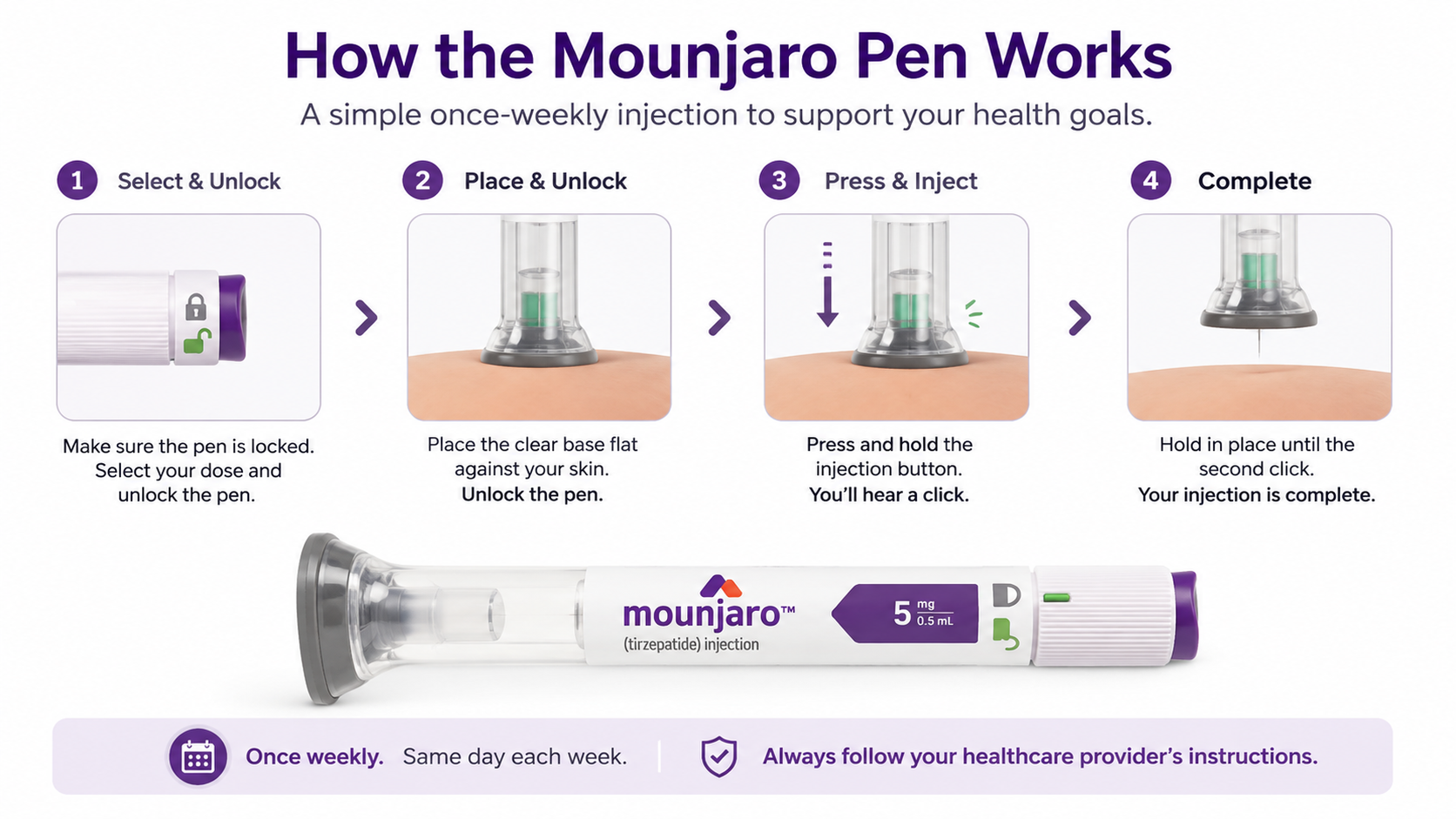
The single-dose prefilled pen holds one dose only and is discarded afterwards. The needle is hidden inside, there is nothing to attach or dial, and you simply unlock it and press it against the skin until it clicks twice.
Everything below describes the KwikPen, since that is what the pens sold here are — the product listings confirm a 2.4 mL multi-dose pen holding four fixed weekly doses, with a new needle required for each injection. If your carton contains single-dose pens instead, the site selection, storage and dosing sections still apply, but skip the needle-attachment and dose-dialling steps and follow the four-step sequence shown further below instead.
Before Your First Injection
Run through this list before you open anything:
- Confirm the strength on the label matches your prescription. The pens look similar; the printed strength is the difference that matters.
- Check the expiry date on the pen and the carton.
- Look at the medicine through the window. It should be clear and colourless to slightly yellow. If it is cloudy, discoloured, or has visible particles, do not use it.
- Check the pen is undamaged and has not been frozen at any point.
- Ask your prescriber or pharmacist to demonstrate once. Watching someone do it, then doing it in front of them, removes most of the first-time anxiety.
- Decide your injection day. Pick a day that is easy to remember and easy to keep — many people choose a Sunday. Set a recurring phone reminder now, not later.
- Get a sharps container. Not a bottle, not a jar. A proper sharps bin, disposed of through your pharmacy or local scheme.
What You Need for Each Dose
- Your Mounjaro KwikPen
- One new pen needle — a fine 4 mm to 8 mm needle such as a 32G BD Ultra-Fine. A fresh needle every single time, with no exceptions.
- An alcohol swab
- Clean cotton or gauze
- A sharps container
Pen needles are usually supplied separately from the pen. Some combination packs, such as the Obeda 4mg Pre-filled Pen supplied with BD Ultra-Fine 32G needles, include them in the box — check your carton so you are not caught short on injection day.
Reusing a needle is the single most common home-injection mistake. A used needle is blunt, which makes the injection hurt more, and it raises the risk of infection and of the needle blocking mid-dose.
Mounjaro Pen Instructions: Step by Step
Step 1 — Take the pen out of the fridge. Let it sit for about 30 minutes to reach room temperature. Injecting cold medicine stings considerably more. Do not warm it in hot water, in the microwave, or on a radiator.
Step 2 — Wash your hands with soap and water and dry them.
Step 3 — Inspect the pen. Check the label, the expiry date and the medicine itself, as above.
Step 4 — Attach a new needle. Pull off the pen cap. Wipe the rubber seal with an alcohol swab. Take a new needle, peel off the paper tab and screw it straight onto the pen until it is firm — not overtightened. Pull off the outer needle shield and keep it (you will need it to remove the needle later). Pull off the inner needle shield and throw it away.
Step 5 — Do the flow check, but only on a brand new pen. Before the first dose from each new pen, turn the dose knob to the flow-check setting shown in your leaflet, hold the pen with the needle pointing upward, tap gently so any air bubbles rise, then press the knob fully until you see a stream or a droplet of liquid at the needle tip. If nothing appears, repeat as your leaflet directs. Do not repeat the flow check for doses two, three and four from the same pen — it wastes medicine and will leave you short.
Step 6 — Dial your dose. Turn the dose knob until your prescribed dose lines up in the dose window. Check it twice. If you overshoot, you can turn the knob back.
Step 7 — Choose and clean the site. Pick a spot on your abdomen, thigh or the back of your upper arm, at least 5 cm away from your navel and away from any bruise, scar, mole or tender area. Wipe with an alcohol swab and let it air dry — injecting into wet alcohol stings.
Step 8 — Inject. Hold the pen so you can see the dose window. Press the needle straight into the skin at a 90-degree angle. Press the dose knob down fully and hold.
Step 9 — Hold for at least 5 to 10 seconds. Keep pressing until the dose window returns to zero, then keep holding for the full count. Pulling out early is the main reason people lose part of a dose. A drop of liquid on the skin afterwards usually means the needle came out too soon.
Step 10 — Remove the pen straight out. If a spot of blood appears, press lightly with cotton. Do not rub or massage the area.
Step 11 — Remove and dispose of the needle. Carefully replace the outer shield, unscrew the needle and drop it straight into your sharps container. Never leave a needle attached to the pen — it can leak, let air in, or block.
Step 12 — Cap the pen and store it. Note the date so you know when the fourth dose is due and when to open a new pen.
Where to Inject and How to Rotate Sites
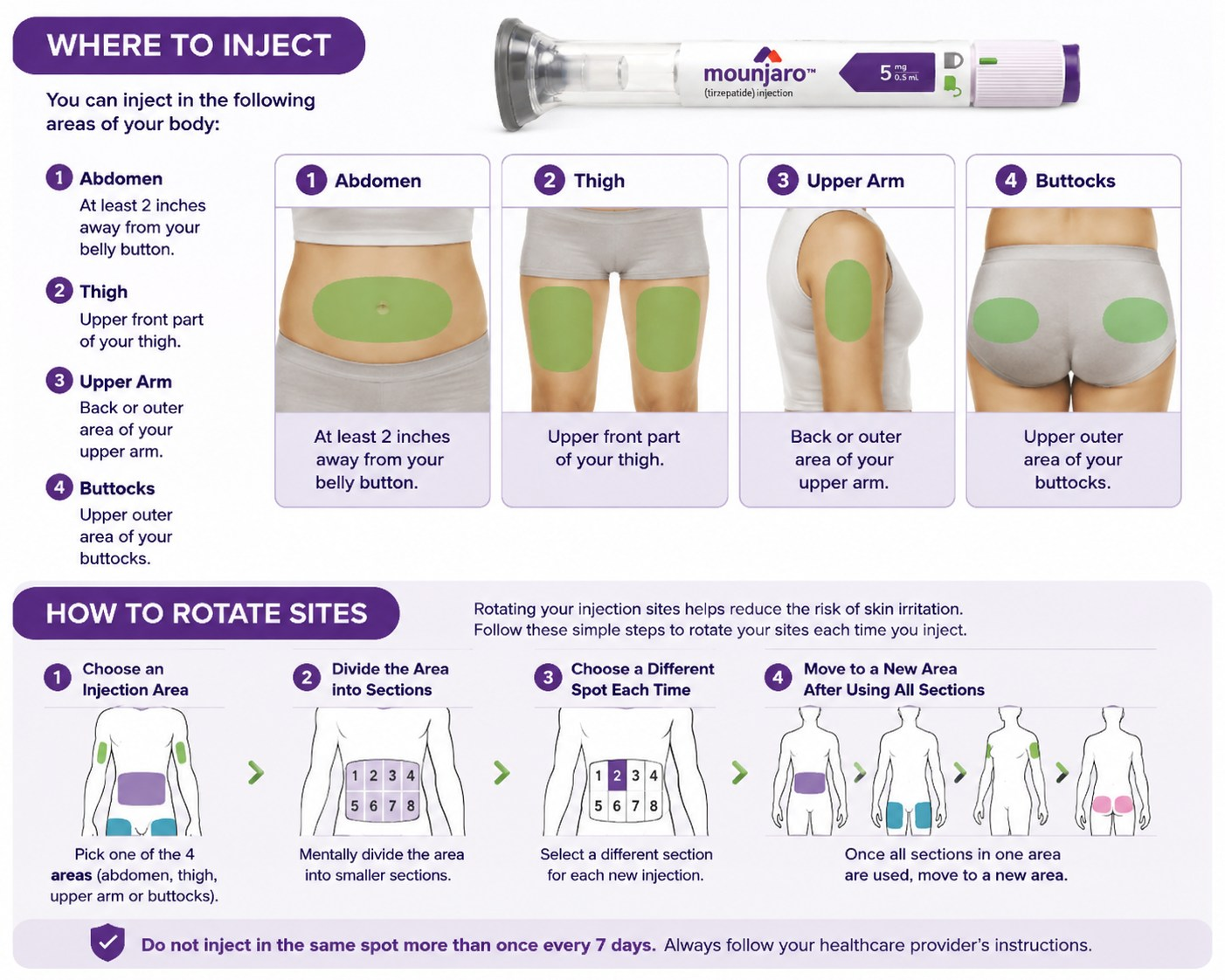
Mounjaro is a subcutaneous injection, meaning it goes into the fat layer just under the skin, not into muscle or a vein. Four areas are approved:
| Site | Notes |
|---|---|
| Abdomen | Most commonly used. Stay at least 5 cm (2 inches) clear of the navel. |
| Front or outer thigh | Easy to reach and see; good for self-injection. |
| Back or outer upper arm | Usually needs another person to do it properly. |
| Upper outer buttock | Less commonly self-administered; usually needs help. |
Rotate every week. Using the same square inch repeatedly causes lipohypertrophy — firm, lumpy patches of thickened fat that absorb medicine unpredictably. A simple system works well: imagine the abdomen as four quadrants and move clockwise each week, so you return to the same quadrant only once a month.
Avoid injecting into skin that is bruised, scarred, hardened, tattooed, inflamed or tender. If you feel a lump forming anywhere you have injected, stop using that area and mention it at your next appointment.
You can inject at any time of day, with or without food. The medicine works over a full week, so the clock time does not matter — consistency of the day is what counts.
Dosage Schedule and Dose Increases
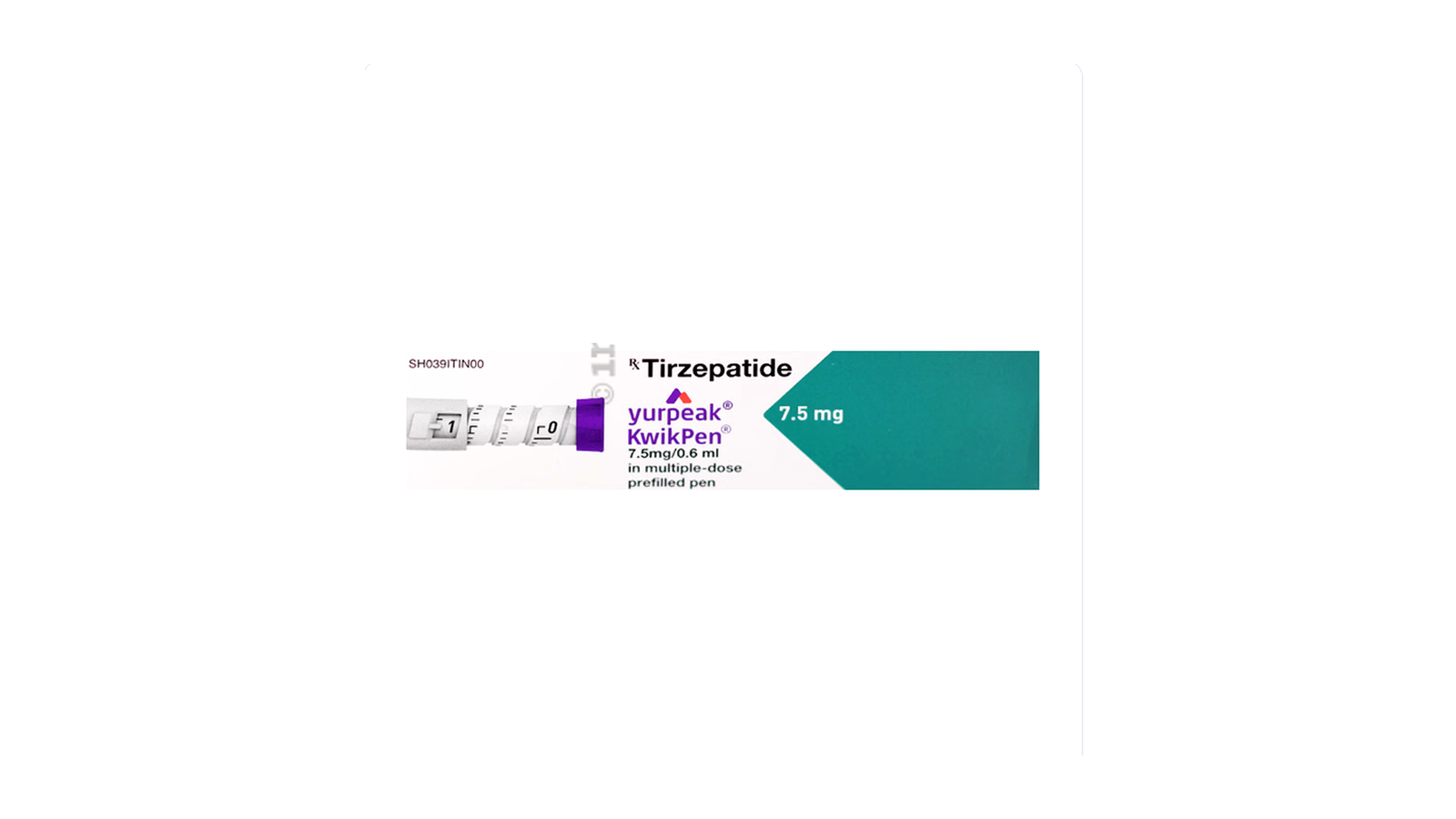
Mounjaro is deliberately started low and increased slowly. This is not caution for its own sake — the stepped schedule is what keeps nausea manageable.
| Phase | Dose | Duration |
|---|---|---|
| Starting dose | 2.5 mg once weekly | 4 weeks |
| First treatment dose | 5 mg once weekly | At least 4 weeks |
| Step up if needed | 7.5 mg, then 10 mg | At least 4 weeks at each step |
| Higher doses | 12.5 mg, then 15 mg | Maximum 15 mg weekly |
A few points that catch people out:
- The 2.5 mg starting dose is not a treatment dose. It exists only to let your stomach adjust. Do not judge how well the medicine works during that first month.
- Increases happen only after at least four weeks at the current dose, and only if your prescriber agrees.
- There is no obligation to reach 15 mg. Many people settle at 5 mg or 10 mg with good results. The right dose is the lowest one that achieves your goal with side effects you can live with.
- If a dose increase makes you feel awful, tell your prescriber. Staying longer at the previous dose, or stepping back down, is a normal adjustment.
- You can change your injection day if you need to, as long as there are at least 3 days (72 hours) between two doses.
If You Miss a Dose
- If you remember within 4 days (96 hours) of the missed dose, inject it as soon as you remember, then carry on with your usual weekly day.
- If more than 4 days have passed, skip the missed dose entirely and take the next one on your normal day.
- Never take two doses within 3 days of each other, and never double up to make up for a missed week.
If you miss several weeks in a row, do not simply restart at the dose you were on. Contact your prescriber — your tolerance drops and you may need to step back down.
Storage Instructions
- Store unused pens in the refrigerator at 2 to 8 degrees Celsius. Keep them in the original carton to protect from light.
- Do not freeze. A pen that has been frozen must be discarded, even if it looks fine after thawing.
- Do not store the pen against the back wall of the fridge or next to the freezer compartment, where it can freeze accidentally.
- Pens may be kept at room temperature, below 30 degrees Celsius, for a limited period — check your leaflet for the exact number of days permitted for your pen type, and discard after that window even if medicine remains.
- Never leave a needle attached during storage.
- Keep the pen out of direct sunlight and away from heat.
- Store out of sight and reach of children.
- Never use a pen past its expiry date, and never share a pen with another person even if you change the needle — this can transmit blood-borne infection.
Side Effects
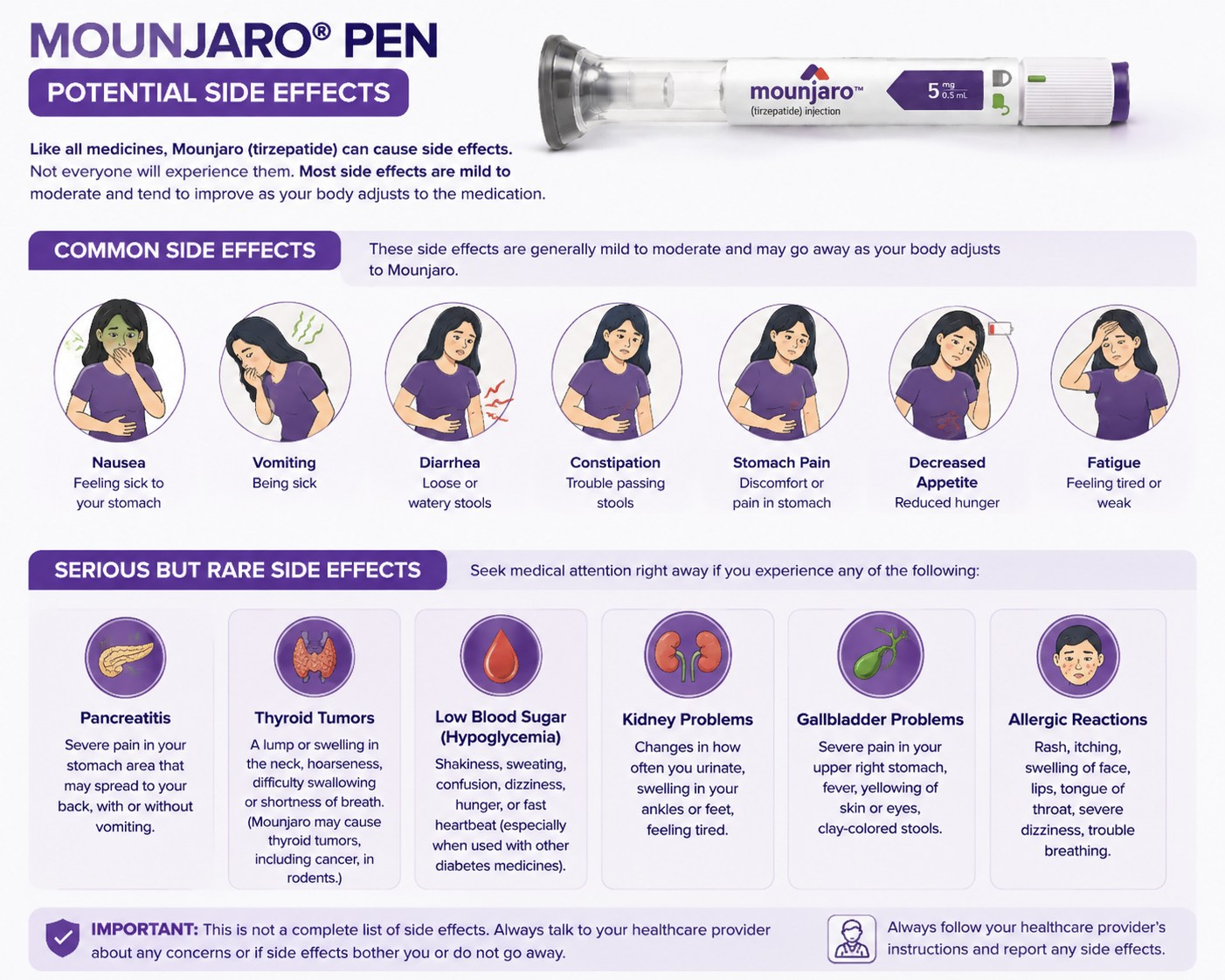
Most side effects are digestive, worst in the first few weeks and after each dose increase, and they settle for most people.
Common
- Nausea, especially in the first days after an injection
- Reduced appetite and early fullness
- Diarrhoea or constipation
- Indigestion, burping, bloating and stomach discomfort
- Tiredness
- Redness, itching or a small lump at the injection site
- Hair thinning, usually linked to rapid weight loss rather than the drug itself
Less common but important
- Low blood sugar (hypoglycaemia) — mainly if you also take insulin or a sulfonylurea such as glimepiride. Your prescriber may reduce those doses when you start.
- Gallstones and gallbladder inflammation, more likely with fast weight loss. Report severe pain in the upper right abdomen, fever or yellowing of the eyes.
- Pancreatitis — severe, persistent abdominal pain that may radiate to the back, often with vomiting. Stop the medicine and seek urgent care.
- Dehydration and kidney strain from prolonged vomiting or diarrhoea. Keep fluids up.
- Worsening diabetic retinopathy in people who already have it and whose blood sugar drops quickly.
- Allergic reactions — rash, swelling of the face or throat, difficulty breathing. This is a medical emergency.
Seek medical help straight away if you notice
- Severe or unrelenting abdominal pain
- Persistent vomiting or signs of dehydration
- A lump or swelling in the neck, hoarseness, trouble swallowing or persistent breathlessness
- Signs of a serious allergic reaction
Who Should Avoid Mounjaro
Mounjaro is not suitable for everyone. Do not use it, or use it only with specialist supervision, if you:
- Have a personal or family history of medullary thyroid carcinoma, or Multiple Endocrine Neoplasia syndrome type 2 (MEN 2). Tirzepatide carries a boxed warning about thyroid C-cell tumours based on rodent studies.
- Have had a serious allergic reaction to tirzepatide or any ingredient in the pen.
- Have type 1 diabetes — Mounjaro is not a substitute for insulin and must not be used for diabetic ketoacidosis.
- Have a history of pancreatitis.
- Have severe gastrointestinal disease, including gastroparesis.
- Are pregnant, planning pregnancy or breastfeeding. Stop at least 2 months before a planned pregnancy and discuss alternatives.
- Are under 18.
Tell your prescriber about any history of gallbladder disease, kidney problems, diabetic eye disease or eating disorders before you start.
Precautions and Warnings
- Mounjaro works alongside diet and activity, not instead of them. Protein intake and resistance exercise matter, because rapid weight loss costs muscle as well as fat.
- Eat smaller meals and stop at the first sign of fullness. Pushing past it is the fastest route to nausea and vomiting.
- Keep hydrated. Dehydration is behind a large share of the serious problems reported with this drug class.
- Tell any surgeon or anaesthetist that you take Mounjaro. Delayed stomach emptying affects fasting instructions before anaesthesia, and this needs to be planned for.
- Do not adjust your own dose, and do not top up from a second pen to reach a dose your pen was not designed to deliver.
- Never use a pen bought without a prescription or from an unverified source. Counterfeit GLP-1 pens are a documented and growing problem.
- Monitor your blood sugar as advised if you have diabetes, particularly during the first weeks and after each increase.
Drug Interactions
| Medicine | Concern | What usually happens |
|---|---|---|
| Insulin | Raised risk of low blood sugar | Prescriber may reduce the insulin dose |
| Sulfonylureas (glimepiride, gliclazide) | Raised risk of low blood sugar | Dose often reduced when Mounjaro starts |
| Oral contraceptive pills | Slowed stomach emptying can reduce absorption | Use a barrier method, or a non-oral contraceptive, for 4 weeks after starting and after each dose increase |
| Oral medicines needing precise timing (thyroid hormone, warfarin, some epilepsy drugs) | Absorption may shift | Closer monitoring may be needed |
| Other GLP-1 medicines such as semaglutide | Duplicate therapy | Never combine two GLP-1 or dual-agonist medicines |
| Alcohol | Adds to nausea and hypoglycaemia risk | Keep intake low, especially early on |
Give your prescriber and pharmacist a full list of everything you take, including supplements and ayurvedic preparations.
Mounjaro vs Ozempic and Wegovy
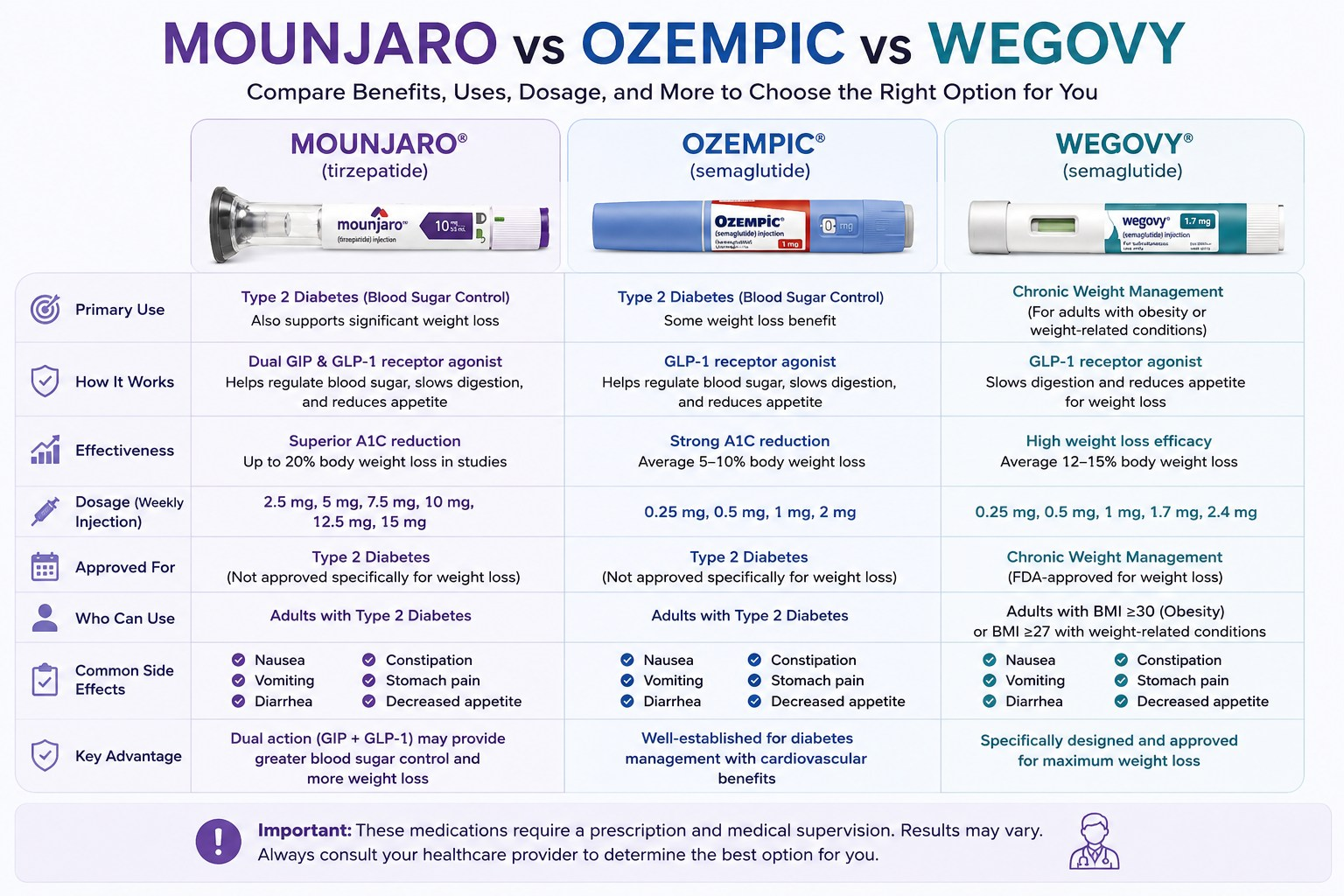
| Feature | Mounjaro (tirzepatide) | Ozempic (semaglutide) | Wegovy (semaglutide) |
|---|---|---|---|
| Mechanism | Dual GIP + GLP-1 agonist | GLP-1 agonist | GLP-1 agonist |
| Licensed mainly for | Type 2 diabetes, weight management | Type 2 diabetes | Weight management |
| Frequency | Once weekly | Once weekly | Once weekly |
| Dose range | 2.5 mg to 15 mg | 0.25 mg to 2 mg | 0.25 mg to 2.4 mg |
| Pen type | KwikPen (4 doses) or single-dose pen | Multi-dose pen | FlexTouch multi-dose pen |
| Typical weight change in trials | Largest of the three | Moderate | Substantial |
All three are prescription medicines with similar handling rules: weekly, subcutaneous, rotate sites, refrigerate. You can compare the options in the weight-management and semaglutide range, but which one suits you is a clinical decision, not a shopping one.
Tips for Best Results
- Same day, every week. Set a repeating alarm and note each injection on a calendar or in a notes app.
- Take the pen out of the fridge 30 minutes early. The single easiest way to make the injection hurt less.
- Keep a simple rotation map. Four abdominal quadrants, one per week. Write down which one you used.
- Eat before the nausea, not after. Small, bland, low-fat meals in the two days after an injection help far more than trying to push through.
- Prioritise protein and some resistance training. This is what protects muscle while you lose weight.
- Do not chase the highest dose. Stay at the lowest dose that is working for you.
- Never skip the fourth dose in a KwikPen thinking the pen is empty — it holds exactly four.
- Keep a spare box of needles. Running out on injection day is a common and avoidable problem.
- Travel with a cool bag and always carry pens in hand luggage, never in checked baggage where they may freeze.
- Review with your prescriber every 3 months to check progress, side effects and whether the dose still fits.
Frequently Asked Questions
1. How many doses are in one Mounjaro KwikPen?
The KwikPen holds four weekly doses, which is a four-week supply. The separate single-dose prefilled pen holds one dose only. Check your carton so you know which design you have.
2. Do I need to prime the pen before every injection?
No. The flow check is done only before the first dose from each new pen. Repeating it before doses two, three and four wastes medicine and can leave you short at the end of the pen.
3. Does it matter what time of day I inject?
No. Mounjaro works across the whole week, so any time of day is fine, with or without food. What matters is keeping to the same day each week.
4. Can I change my injection day?
Yes, provided there are at least 3 days (72 hours) between the last dose and the new one. After that, continue weekly on the new day.
5. What if I see a drop of liquid on my skin after injecting?
That usually means the needle was withdrawn before the full dose was delivered. Do not inject again to compensate. Next time, keep the knob pressed and hold the needle in place for the full 5 to 10 seconds after the dose window reaches zero.
6. Which injection site is best?
The abdomen is the easiest to reach and see, keeping at least 5 cm from the navel. The thigh and the back of the upper arm are also approved. Rotating between sites matters more than which one you pick.
7. Can I keep my pen out of the fridge?
For a limited period only, below 30 degrees Celsius, and the exact number of days depends on your pen type — check your leaflet. Beyond that window the pen must be discarded. Never use a pen that has been frozen.
8. Will the nausea go away?
For most people it eases after the first few weeks and again a week or two after each dose increase. Smaller, lower-fat meals help. If you are vomiting repeatedly or cannot keep fluids down, contact your prescriber rather than pushing on.
9. What happens if I stop Mounjaro?
Appetite generally returns and weight tends to come back unless eating and activity habits have changed alongside the medication. For type 2 diabetes, blood sugar will usually rise again. Discuss any plan to stop with your prescriber rather than simply stopping.
10. Is Mounjaro available without a prescription?
No. Tirzepatide is a prescription-only medicine everywhere it is licensed. Pens sold without a prescription carry a real risk of being counterfeit, and counterfeit GLP-1 pens have caused serious harm.
Conclusion
The Mounjaro pen looks intimidating on day one and becomes routine by week three. The parts that genuinely matter are simple: use a new needle every time, flow-check only a new pen, hold the injection for a full 5 to 10 seconds, rotate your sites, and respect the four-week gap between dose increases.
The rest is habit. Pick a day, set a reminder, take the pen out of the fridge half an hour early, and keep a sharps bin somewhere sensible. Eat smaller meals in the two days after your injection and drink more water than you think you need.
And keep your prescriber in the loop — about side effects, about dose increases, and about whether the dose you are on is still the right one. Tirzepatide is an effective medicine used properly and a risky one used casually.
Browse the Mounjaro and tirzepatide range at PMC Herbals. Valid prescription required for all pens.
Medical Disclaimer
This article is general educational information only. It is not medical advice and does not replace the Instructions for Use supplied with your pen or the guidance of your own prescriber.
Mounjaro (tirzepatide) is a prescription-only medicine. Do not start it, stop it, or change your dose based on anything in this article. Pen designs and storage windows vary between countries, manufacturers and batches — always follow the leaflet inside your carton.
If you experience severe abdominal pain, persistent vomiting, signs of a serious allergic reaction, or a lump or swelling in your neck, stop using the medicine and seek medical attention immediately.
PMC Herbals does not dispense prescription medicines without a valid prescription and does not accept liability for decisions made solely on the basis of this content.